
You're here: Home > About us > About us > News
Fuel market - conclusions of the investigation procedure
share it


< previous | next > 07.06.2023

- The investigation procedure regarding the fuel market has been completed. The prices charged by PKN Orlen at the end of 2022 were without prejudice to competition law. The case was consulted with the European Commission.
- UOKiK’s findings are preceded by economic analyses and in line with the case-law of the European Commission, the Court of Justice of the European Union and the European antitrust authorities.
At the beginning of 2023, there was great excitement about petrol and diesel prices. UOKiK received numerous complaints suggesting that prices charged at the end of 2022 by PKN Orlen could constitute an abuse of a dominant position by the company. Consequently, and on the basis of his own monitoring, the President of the Office initiated an investigation procedure concerning the fuel market. The procedure was conducted on the basis of both Polish and EU regulations. UOKiK consulted the European Commission on its activities.
- We understand the emotions and dissatisfaction of drivers with fuel prices at the end of the year. At the same time, our role was to thoroughly examine the conduct of an entrepreneur on the legal basis. In our procedure, which we consulted with the European Commission, we have carefully examined the situation on the fuel market at the end of last year. We reviewed the way Orlen had set its prices and carried out economic tests to verify whether these were excessive prices within the meaning of the antitrust regulations. We have also benefited from the experience and judgment of other EU antitrust bodies, the European Commission and the Court of Justice of the EU. The investigation showed that the fuel prices charged by Orlen in December 2022 decreased slower than the quotations of fuel prices on European markets. However, this did not constitute a breach of law under Polish and EU competition protection regulations. The level of prices charged by Orlen at the end of the year was lower than the levels recognised in case law as abuse of a dominant position through the use of excessive pricing - says UOKiK President Tomasz Chróstny.
Prices charged by PKN Orlen at the end of 2022
As part of the investigation procedure, UOKiK has repeatedly addressed PKN Orlen with requests for further information and data concerning, in particular: shaping wholesale fuel prices in the second half of 2022, the manner of setting these prices (including indices and price formulas used for this purpose), volumes of fuels sold, prices applied in other countries where the company is present, price and discount policies for individual buyer groups, stock volumes or capacity volumes of refineries.
In addition, UOKiK requested Aramco Fuels Poland (formerly Lotos Paliwa sp. z o.o.), and other fuel companies operating on the Polish market to provide, inter alia, commercial data on fuel prices charged.
UOKiK also sent two requests to the European Competition Network, which comprises the European Commission and the competition authorities of EU Member States, asking for information on whether these authorities had observed any irregularities in their own fuel markets in the second half of last year and whether they had taken action on antitrust regulation grounds as a result.
UOKiK’s findings
Orlen sets the so-called SPOT price for fuels (diesel and petrol). It is determined by certain mathematical formulas based on different market factors. One of these is the quotation of a given type of fuel on international commodity exchanges. In the course of the procedure, UOKiK obtained detailed information on the manner in which SPOT prices were calculated by Orlen and analysed source data constituting the basis for determining these prices in the period from June 2022 to the end of January 2023.
The SPOT price is the reference price (reference price). On the other hand, the actual transaction prices, i.e. the prices at which wholesale buyers (e.g. fuel station owners) buy fuel from Orlen, are set taking into account rebates and discounts granted on the SPOT price. Each fuel station then determines its own retail price, which the consumer pays.
From around mid-November 2022, fuel price quotations on international markets began to fall steadily. This concerned both the quotation of petrol and diesel prices. At the same time, Orlen’s SPOT prices did not fall as dynamically and proportionally as the quotations used to determine this price.
In determining whether Orlen’s prices were excessive, UOKiK adopted two benchmarks. The first is what prices would have been if Orlen had set them in the same way as on 10 November 2022. The second is the prices set as they would have been on average over the 12 months (1 October 2021 to 30 September 2022).
The analysis of SPOT price deviations from these benchmarks indicated that they were not high enough and at the same time not long enough to speak of excessive pricing according to previous decisions of the European Commission, national antitrust authorities, as well as rulings of the Polish Supreme Court or the Court of Justice of the European Union.
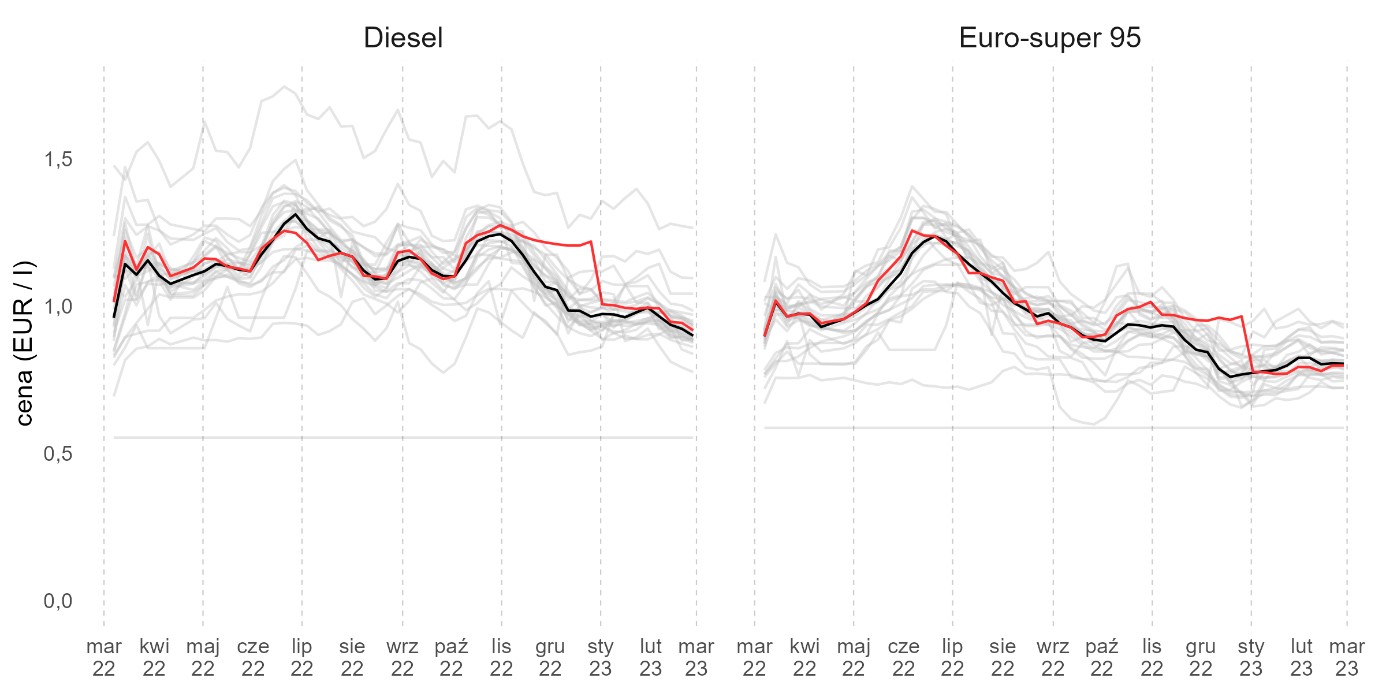
UOKiK also analysed the evolution of fuel prices in Poland compared to other domestic markets. For this purpose, it used weekly data published by the European Commission on tax-free retail prices in EU countries (available at https://energy.ec.europa.eu/data-and-analysis/weekly-oil-bulletin_en). While these are retail prices, not wholesale prices, the elimination of public burdens from them and the fact that the wholesale price of fuel represents a major part of its retail price allow them to be used to illustrate the situation on the Polish market against the markets of other EU countries.
The analysis showed that although in December 2022 the deviations of fuel prices in Poland from the median prices in the EU countries were higher than normal, it was not an unprecedented level in other countries. A significant number of observations can be found in the EC database with deviations from the median prices in EU countries higher than the highest such deviation for Polish prices – 91 cases for Pb 95 and 258 cases for ON.
The following graph shows the position of the price in Poland in a given week (the first item means the highest price) from March 2022 to the end of February 2023.
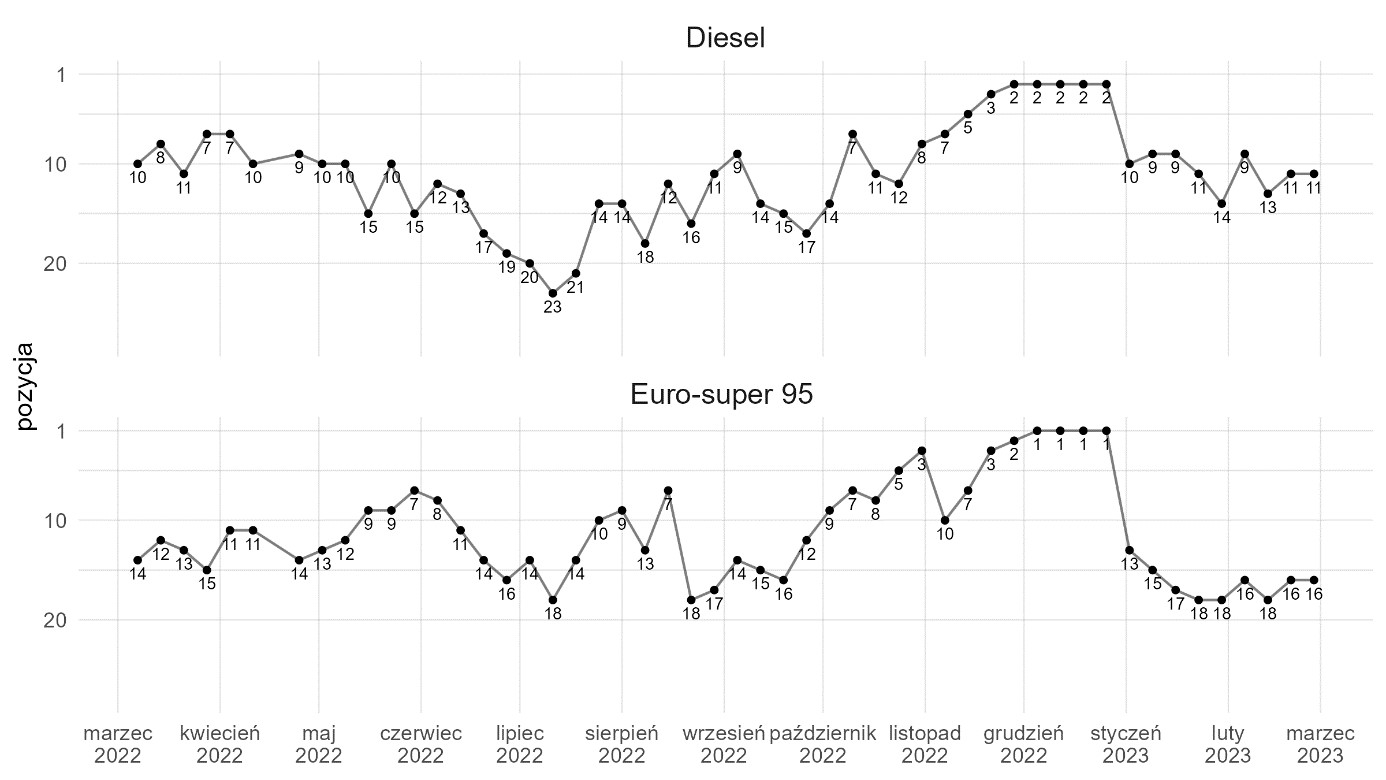
As can be seen, the price in Poland before November 2022 was in principle lower than the ninth place in the EU. This position increased in November and petrol prices were higher in Poland in December than in other EU countries, while diesel prices were in the second place behind Sweden. In January, fuel prices in Poland fell sharply compared to other EU countries, and the price position in Poland returned to long-term levels. This clearly shows that the increase in fuel prices in Poland compared to EU countries was temporary and short-term.
Case law of the European Commission and EU competition authorities
In a free market economy, entrepreneurs are free to set prices. They are the result of the game of demand and supply. There are only few exceptions where competition authorities can indirectly interfere with price formation. One is the practice of excessive pricing by those holding a dominant position in a given market. Importantly, holding a dominant position is not forbidden, it is forbidden to abuse it.
However, there is no clear definition of excessive pricing. One common point in the jurisprudence of the Court of Justice of the European Union, the European Commission or the European antitrust authorities is that prices must be inflated “significantly” and be applied “permanently”. This means that not every application of high prices (prices wrongly assessed by consumers) is in breach of antitrust law. Investigations into excessive pricing by antitrust authorities are also very sporadic. They most often concern the price of medications.
An example is the decision of the European Commission of 2021 on Aspen, a company operating on the pharmaceutical market. The prices charged by the entrepreneur increased by approx. 200-600% (depending on the type of medication), with costs increasing by 10% – 40% (and in the case of one medication even decreasing), respectively. In the Commission’s view, this imbalance showed that these prices remained significantly inflated[1].
The cases handled by the European antitrust authorities largely concerned markets in which entrepreneurs enjoyed exclusivity arising from their patent protection for their medications, which had no substitutes. In Italy, for example, two cases involved significant price increases for medications for rare diseases (increases ranging from 250 to 1,500 %). In Denmark, too, the only issue was the increase in the price of medications - by 2,000 %. The Dutch and Spanish authorities have also had one case each against the same entrepreneur (Leadiant) in the last 10 years, concerning a significant increase in the price of a medication.
Not all decisions in cases of abuse of dominance through excessive pricing are later upheld by the courts. An example is the French authority’s decision on the systematic increase in the price of services by the only recipient of medical waste in Corsica over four years. The increases amounted to as much as 194 % between 2011 and 2015. The French court stated that these prices were not unfair[2].
In this context, it is also worth mentioning the judgments of the Polish courts on the 2000 decision, in which the then President of UOKiK considered that PKN Orlen had set the sales prices of petrol and diesel in a way that allowed it to obtain unjustified benefits. The administrative investigation revealed that from 1 January to 28 October 1999, Orlen raised fuel prices seventeen times. The entrepreneur appealed to the court, which overturned the decision, which was eventually confirmed by the Supreme Court in 2003.[3]
CJEU jurisprudence
In its investigation procedure, UOKiK also took into account the case-law of the Court of Justice of the European Union. According to the CJEU judgments, not every high price charged by an undertaking in a dominant position is excessive and unlawful, but only that which is “disproportionate” or “excessive” and “persistent”. According to the Opinion of the Advocate General of the CJEU in one of the cases, “The occurrence of periodically high prices in parallel with periods characterised by low prices is considered in the economic literature to be consistent with a well-functioning competitive market. Therefore, a price that fluctuates constantly and only occasionally exceeds competitive levels will not, in my view, give rise to serious competition concerns. Only if the price remains at a level above the reference price (or cyclically exceeds that level) for a significant period of time can the price be considered abusive within the meaning of Article 102 of the Treaty on the Functioning of the European Union”.[4].
Comparison of PKN Orlen and Aramco Fuels Poland prices
UOKiK also examined the similarity of the SPOT prices of fuels announced by PKN Orlen and Aramco Fuels Poland at the turn of 2022 and 2023. The analysis does not indicate any coordination between the entrepreneurs in terms of pricing. Aramco Fuels Poland began independently publishing its own SPOT prices at the beginning of December 2022. Although the prices initially showed convergence with those of PKN Orlen, they were not always identical and, from around mid-January 2023 onwards, have already shown consistent variation in principle. Furthermore, in assessing the situation, UOKiK took into account that SPOT prices are in principle not proper transaction prices but reference prices from which PKN Orlen and Aramco grant discounts and rebates based on their individual pricing policies.
Further monitoring of the fuel market
The investigation into fuel prices has been completed. UOKiK will continue to monitor the situation on the market and does not exclude further actions in the future if there is a suspicion of a breach of the law.
Additional information for the media:
UOKiK Press Office
pl. Powstańców Warszawy 1, 00-950 Warszawa, Poland
Phone: 22 55 60 246
Email: [SCODE]Yml1cm9wcmFzb3dlQHVva2lrLmdvdi5wbA==[ECODE]
Twitter: @UOKiKgovPL
You can also follow us on Instagram: @uokikgovpl
[1] Aspen Case No. AT.40394.
[2] Decision 18-D-17 of 20 September 2018.
[3] Antitrust Court judgment of 11.10.2000 in case XVII AmA 65/00, Supreme Court judgment of 16.05.2003 in case I CKN 337/01
[4] Opinion of the Advocate General and judgment of the CJEU of 14.09.2017. – AKKA/LAA (C-177/16)
Attached files
- Press release (372,9 KB, docx, 2023.06.07)
Search
-
Contact
Office of Competition and Consumer Protection
Plac Powstańców Warszawy 1
00-950 Warszawa
Phone: +48 22 55 60 800
E-mail: [SCODE]dW9raWtAdW9raWsuZ292LnBs[ECODE] - Reports


Home
Contact
Privacy policy
Accessibility
Site map
Mobile version


design by VENTI © UOKiK 2026. All rights reserved.